


Wixie
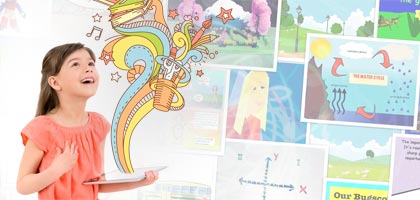
Student publishing and creativity platform. Users can search and insert images from Pics4Learning within the application.

Pixie
Software for student publishing and creativity.

Wixie
Online student publishing and creativity platform.

Frames
Create animations, digital stories, and stop-motion.

Share
Create web sites, epubs, and presentations.
These software tools let users search and insert images from Pics4Learning within the application.

Lesson Plans
High-level ideas for engaging students and using Pics4Learning images in the classroom.

Creativity
Articles to help build powerful thinking skills with creativity.

Digital Storytelling
Articles and ideas for engaging students with digital storytelling.

21st Century Classrooms
Articles to help you create a 21st century classroom and build 21st century skills.
Articles, ideas, and lessons for engaging students with technology.


His work merges the fluid dynamics of water with the jagged energy of punk rock. He draws airbrushed explosions of color where a longboard transforms into a Roman chariot, or where a punk guitarist’s fingers bleed lightning bolts.
But one image towers above them all: the Designed in 1985 as a logo for the Speed Wheels line, the Screaming Hand transcended its commercial origins to become a global phenomenon. It’s an image of intense, slightly unhinged energy—a disembodied hand screaming from the center of a deck, its fingers splayed and distorted with raw power. It immediately connected with skateboarders worldwide. It is, as one article puts it, “intense, slightly unhinged and unmistakably part of skateboarding’s visual DNA”. This single graphic defined the aggressive, DIY spirit of 80s skate culture, blossoming into stickers, wheels, and T-shirts found in 85 countries. His work merges the fluid dynamics of water
The book was originally released as a trade paperback through Schiffer Publishing It’s an image of intense, slightly unhinged energy—a
"Surf, Skate & Rock Art of Jim Phillips: 40 Years of Surf, Skate and Rock Art" is a 208-page retrospective featuring 937 illustrations that chronicle the influential career of artist Jim Phillips from the 1960s to the early 2000s. Published by Schiffer Publishing, the book covers his work in surf culture, rock posters, and iconic skateboard graphics like the Screaming Hand. Explore the book's details at Schiffer Publishing . Share public link This single graphic defined the aggressive, DIY spirit
The book begins by diving into his surf art, where his love for the ocean is palpable. As a local Santa Cruz surfer himself, Phillips didn't just depict the sport from an outside perspective; he captured the feeling of gliding across a wave, the sun beating down, and the laid-back, yet rebellious, attitude of the beach culture that defined California in the 60s and 70s.
The final thread weaves in his work for rock and roll. From psychedelic '60s posters for bands like The Grateful Dead (influenced by his contemporaries like Rick Griffin) to gritty flyers for punk venues, the book shows how Phillips adapted his style to the rhythm of the music. It captures the transition from flower power to the mosh pit, illustrating how his art became the visual soundtrack for the West Coast underground.
If you manage to locate the 176 pages of this PDF, you are in for a chronological masterclass. Here is how the book breaks down the four decades.

Creative Educator
A free source of strategies to foster creativity, and integrate technology into the classroom.

Rubric Maker
Create custom rubrics for your classroom.
Wixie
An online student publishing and creativity platform.


