ASComm IoT
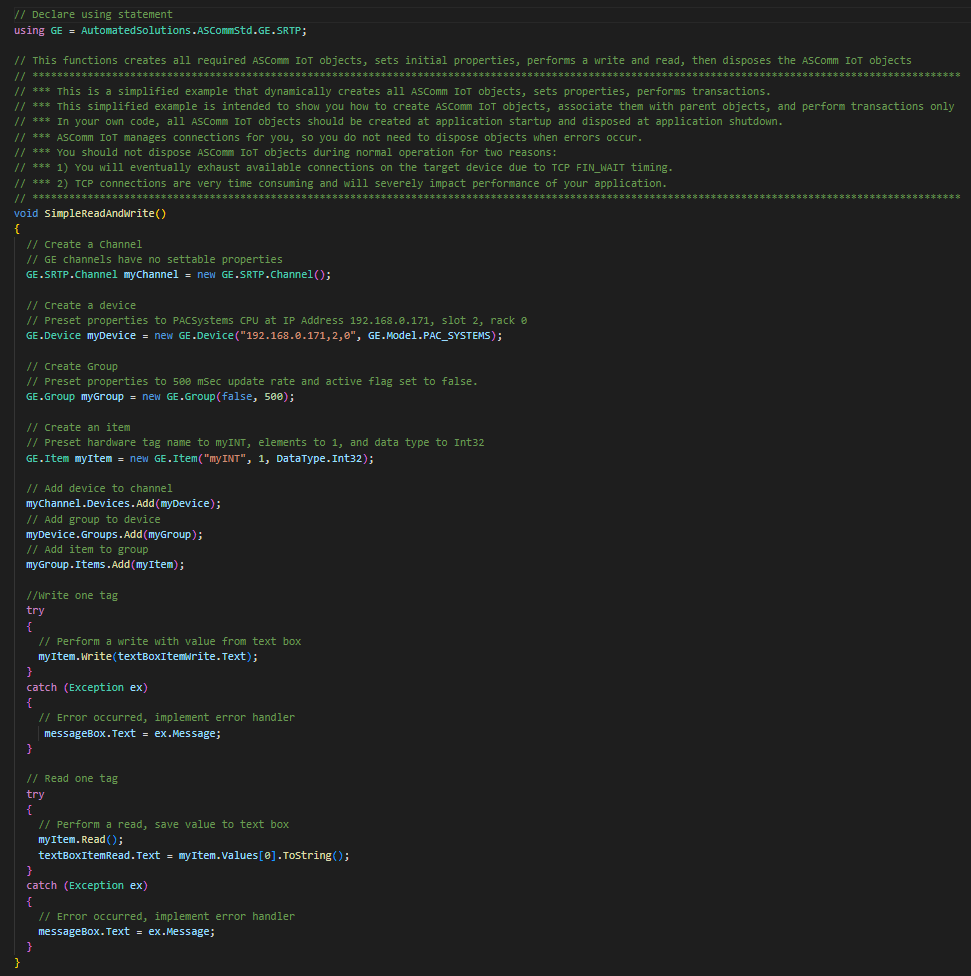
GE IoT Software Driver Example Application
Simple Read and Write

GE IoT Software Driver Code Example
ASComm IoT GE SRTP Ethernet Driver is a communications library that enables your .NET 10/9/8 applications to read and write registers on PACSystems RX3i, RX7i, Rxi, Series 90-30, and VersaMax controllers without PLC program modifications, OPC or third party libraries.
PACSystems symbolic register naming supported.
Use Visual Basic, C#, C++, and ASP.NET to create HMI, SCADA, data logging, and Industrial IoT applications targeting Windows, Linux and Android.
Powerful pre-built example applications with VB and C# source code included in development package.
Runtime-free for qualified applications
Every compelling character enters a story with past trauma, a core insecurity, or a false belief about the world (their "lie").
As our real-world dating habits shift, fictional relationships and romantic storylines must adapt to reflect these new realities. The introduction of smartphones, dating apps, and long-distance digital communication has radically altered the mechanics of courtship plots.
But what makes a romantic narrative truly compelling? Why do certain relationships leave an indelible mark on our collective culture, while others fade into cliché? To understand the enduring power of romantic storylines, we must examine their psychological roots, their narrative structures, and the way they evolve alongside society.
I can expand this piece further depending on your specific needs. Let me know if you would like to focus on:
From Romeo and Juliet to contemporary dystopian dramas, forbidden love uses the external world as the primary antagonist. Society, family, class, or war dictates that the couple cannot be together. This structure amplifies the intensity of the romance, framing the relationship as an act of rebellion against an unjust world. 3. The Shift From "Happily Ever After" to "Happily For Now"
A major misunderstanding, a secret revealed, or an external crisis forces the couple apart. This is the lowest emotional point of the narrative, where a future together seems entirely impossible.
The best fictional couples act as mirrors and catalysts for each other. Character A’s weakness should be challenged by Character B’s strength, forcing both to grow in ways they couldn't achieve alone.
It started with a spilled latte and an apology that felt a little too sincere. Most people would have walked away after a quick "sorry," but he stayed to help me mop up the mess with napkins that were doing more smearing than soaking.
At its core, a great romantic storyline is a masterclass in emotional engineering. It leverages the most powerful psychological principle of all: .
If you are working on creating your own narrative or studying media trends, I can help you expand this concept further.
The foundation of trust that keeps a romantic storyline grounded.
Every compelling character enters a story with past trauma, a core insecurity, or a false belief about the world (their "lie").
As our real-world dating habits shift, fictional relationships and romantic storylines must adapt to reflect these new realities. The introduction of smartphones, dating apps, and long-distance digital communication has radically altered the mechanics of courtship plots.
But what makes a romantic narrative truly compelling? Why do certain relationships leave an indelible mark on our collective culture, while others fade into cliché? To understand the enduring power of romantic storylines, we must examine their psychological roots, their narrative structures, and the way they evolve alongside society.
I can expand this piece further depending on your specific needs. Let me know if you would like to focus on:
From Romeo and Juliet to contemporary dystopian dramas, forbidden love uses the external world as the primary antagonist. Society, family, class, or war dictates that the couple cannot be together. This structure amplifies the intensity of the romance, framing the relationship as an act of rebellion against an unjust world. 3. The Shift From "Happily Ever After" to "Happily For Now"
A major misunderstanding, a secret revealed, or an external crisis forces the couple apart. This is the lowest emotional point of the narrative, where a future together seems entirely impossible.
The best fictional couples act as mirrors and catalysts for each other. Character A’s weakness should be challenged by Character B’s strength, forcing both to grow in ways they couldn't achieve alone.
It started with a spilled latte and an apology that felt a little too sincere. Most people would have walked away after a quick "sorry," but he stayed to help me mop up the mess with napkins that were doing more smearing than soaking.
At its core, a great romantic storyline is a masterclass in emotional engineering. It leverages the most powerful psychological principle of all: .
If you are working on creating your own narrative or studying media trends, I can help you expand this concept further.
The foundation of trust that keeps a romantic storyline grounded.