Miodowe Lata Odcinki Online Za Darmo Better |best| Jun 2026
All About Digital Photos

Miodowe Lata Odcinki Online Za Darmo Better |best| Jun 2026

The good news is that you don't need a Netflix or HBO Max subscription to enjoy this classic. In fact, it's not available on those platforms at all. Instead, "Miodowe Lata" is legally distributed for free on three main Polish streaming services: . Each has its own strengths, and I'll compare them in detail below.

Czy ten artykuł pomógł Ci znaleźć lepsze źródło? Daj znać w komentarzach lub podziel się swoją metodą na oglądanie "Miodowych lat" bez reklam!

często można znaleźć aktualnie emitowane odcinki dostępne do obejrzenia online za darmo. CANAL+ online : Platforma oferuje dostęp zarówno do klasycznych Miodowych lat , jak i kontynuacji pod tytułem Całkiem nowe lata miodowe miodowe lata odcinki online za darmo better

: Jako oficjalna platforma nadawcy (Polsat), oferuje dostęp do biblioteki odcinków, w tym takich klasyków jak „ Żywe zwłoki ” czy „ Dola idola

Do najbardziej kultowych motywów, dla których warto odświeżyć sobie poszczególne sezony, należą: Słynne zebrania i rytuały w Klubie Sierżanta, Szalone, skazane na porażkę biznesowe pomysły Karola, Wieczne kłótnie z teściową oraz doktorem Zawiszą, The good news is that you don't need

– Genialne sceny przesłuchania i ukrywania się w mieszkaniu. Instrukcja krok po kroku: Jak włączyć serial już teraz

Pamiętaj: "Miodowe lata" to skarb polskiej komedii. Zasługuje na to, by oglądać go w wersji – bez pikseloz, bez wirusów, z pełną przyjemnością słuchania kultowego "Paździochu, nie wierć się!". Each has its own strengths, and I'll compare

They occasionally offer 7-day free trials for new subscribers. Keep an eye on current promotions to catch the episodes during a trial period.

Czy chciałbyś, abym przygotował z serialu, które możesz wykorzystać w social mediach?

to coś więcej niż serial – to kawałek historii polskiej telewizji. Szukając odcinków online za darmo , zawsze wybieraj oficjalne źródła, które wspierają twórców i gwarantują najlepsze wrażenia z oglądania. Bez względu na to, czy oglądasz po raz pierwszy, czy po raz setny – Karol i Tadzio zawsze poprawią Ci humor.

 
Changing the DPI

DPI vs PPI - please note that references here to DPI (Dots Per Inch) actually means PPI (Pixels Per Inch). I continue to use DPI since that's still how many people (incorrectly) understand it. And with some software (i.e. most scanning software), you'll still see DPI used where PPI is what is actually meant. DPI (meaning printer dots per inch) is essentially an obsolete term. But it's still in very common use as a term to mean PPI. See What is DPI. At some point I'll change all my DPIs to PPIs - but that's another project for another day :-)


If you've come here after reading my article "The Myth of DPI" you'll already know that DPI has nothing to do with digital image resolution or quality. However, some people and places who are still ignorant of that fact (many graphics designers, magazines and print shops) still insist of getting a photo with an internal setting of ___DPI (usually 300 DPI) even when the photo's pixel resolution is sufficient to print the photo at the required PPI. The easy solution (rather than trying to educate them about real digital photo resolution) is to simply change the DPI setting of your image to whatever they want and send it along to them.

You may also wish to change the DPI so that the image will default size to the intended print dimensions when loaded into a word processor or desk top publishing program. For instance, if you want to set a 1500 pixel wide photo so that it will default to a 4 inch print dimension, then change the DPI setting of the photo to 375 DPI (1500 pixels divided by 4 inches = 375 pixels per inch).

The trick when changing the DPI is to do it without resizing (resampling) your image in the process. You want to change the DPI while retaining the original pixel dimensions (the real digital resolution) of the photo. I'll provide three examples, one using Adobe Photoshop (Windows & mac) and the other two using the free programs XnView (Windows, Linux & mac) and Irfanview (Windows).

Note that this procedure will not change the digital photo in any way other than to alter the internal DPI setting. The size and resolution of the digital image will be unchanged.

XnView Method
    miodowe lata odcinki online za darmo better
    note that the "Resample Image" box is UNCHECKED and that the "Print Size" has been set to 300
  1. Open a folder with images and select an image to show full view.
  2. Select the "Image > Resize" menu option (not the "set DPI" option)
  3. In the image size dialog window, deselect the "Resample Image" checkbox (make sure there is no checkmark in that box).
  4. In the "Resolution" box type in 300 (or whatever DPI you want)
  5. Click the "OK" button
  6. Your image DPI has now been set to whatever you want (leaving the pixel dimensions of the image unchanged).
  7. Save this photo with a new name - I suggest adding a -300dpi extender (i.e. "345-2365-300dpi.jpg") to identify this new DPI image.
  8. See note below when saving to JPEG format
Earlier versions of XnView had a bug in which the DPI change wasn't recognized by programs such as Adobe Photoshop. This was fixed in 2009, so any current version is fine. There is a direct "set DPI" option, but you have to make sure to adjust both the X and Y to identical values (only the X value will be recognized by Photoshop, I'm not sure what happens with the Y, hence best to stick with the "Resize" dialog).
Adobe Photoshop Method
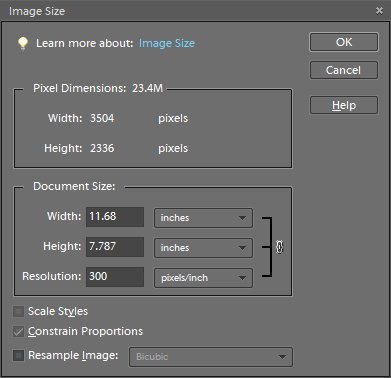
    adobe - change dpi
    note that the "Resample Image" box is UNCHECKED
    and that the "Resolution" has been set to 300
  1. Load your image into Adobe Photoshop (or Photoshop Elements).
  2. Select the "Image > Image Size" menu option (may be "Image > Resize > Image Size" in Photoshop Elements).
  3. In the image size dialog window, deselect the "Resample Image" checkbox (make sure there is no checkmark in that box).
  4. In the "Resolution" box type in 300 (or whatever DPI you want)
  5. Click the "OK" button
  6. Your image DPI has now been set to whatever you want (leaving the pixel dimensions of the image unchanged).
  7. Save this photo with a new name - I suggest adding a -300dpi extender (i.e. "345-2365-300dpi.jpg") to identify this new DPI image.
  8. See note below when saving to JPEG format

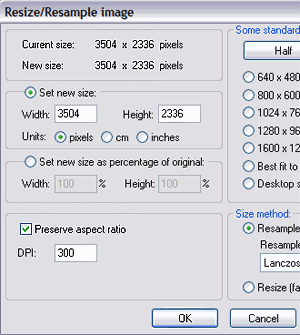
Irfanview Resize Image Dialog Box
Irfanview Method
  1. Load your image into Irfanview
  2. Select the "Image > Resize/Resample" option
  3. In that dialog window you'll see a specific DPI data box
  4. Simply enter whatever DPI you want without adjusting anything else in that dialog window.
  5. Click on the "OK" button
  6. Your image DPI has now been set to whatever you want (leaving the pixel dimensions of the image unchanged).
  7. Use "Save As" to save this photo with a new name - I suggest adding a -300dpi extender (i.e. "345-2365-300dpi.jpg") to identify this new DPI image.
  8. See note below when saving to JPEG format

Saving to JPEG - please note that JPEG is a digital photo format that uses variable compression - that is, you can change the compression. Your camera should (if you have it set correctly) be using low compression (highest quality). To emulate this when doing a "save as" from a photo program, choose a compression of about 95 (Adobe Quality 10+).

If you are using XnView, when you do a JPEG save, click on the "Options" button to give you the JPEG save dialog and move the slide towards "Best" to whatever number (i.e. 95) you wish. Using Irfanview, when you do a "Save As" in JPEG format, note the dialog box with the JPEG options - move the slider to 95 (or higher if you wish) for best image quality. With Adobe Photoshop (incl. Elements) - choose quality 10 or higher in the dialog box that comes up when you do a Save As in JPEG format.

A verification is to check the image filesize (in kilobytes or megabytes) of your copy of the photo against the original digital photo. They probably won't be identical, but should be close. If there is a big discrepancy in filesize then you've done something wrong.

Other Programs

Other photo programs are going to have a similar process. The key is to make sure that the image IS NOT being resampled (pixel resized) when the DPI is changed. As long as the pixel dimensions remain unchanged, your new DPI photo will be identical to your original photo, only the internal DPI setting of the photo will have been changed. Your print shop, graphics designer or magazine should be happy campers with your "new higher DPI" image.


Home   •   What Is | Filetypes | Colour Models | Acronyms and Nomenclature | Frequently Asked Questions (FAQ)   •   Storage   •   Digital Labelling | Visible Captioning   •   What Is DPI | Myth DPI | Change DPI   •   Changing Size   •   Print Shops | Arithmetic of DPI | FAQ | Photoshop Dialog Box   •   Home Printing | Print Shops   •   Geotagging   •   Scanning   •   Digital Images and Genealogy | Make Your Photos Last Forever | Camera or Scanner | Copying Old Photos | Workflow Examples | Visible Captioning | Choosing a Camera | Print Longevity | Sending Photos to Relatives

Comments: send me email:

URL: www.rideau-info.com/photos/changedpi.html
© 2003- Ken W. Watson